
What is Coronary Angioplasty?
Coronary angioplasty, also known as percutaneous coronary intervention (PCI), is a minimally invasive cardiac procedure used to open narrowed or blocked coronary arteries and restore normal blood flow to the heart muscle. It is one of the most widely performed and clinically proven treatments for coronary artery disease, offering significant relief from symptoms like chest pain and breathlessness without the need for open heart surgery. In emergency situations such as a heart attack, angioplasty can be performed immediately to reopen the blocked artery and limit damage to the heart.
The procedure works by guiding a thin flexible catheter with a tiny balloon at its tip through a small puncture in the wrist or groin, all the way to the site of the blockage in the coronary artery. Once in position, the balloon is inflated to compress the fatty plaque against the artery wall and widen the passage for blood flow. In most cases, a small metal mesh tube called a stent is placed at the same site to keep the artery open permanently and prevent it from narrowing again.
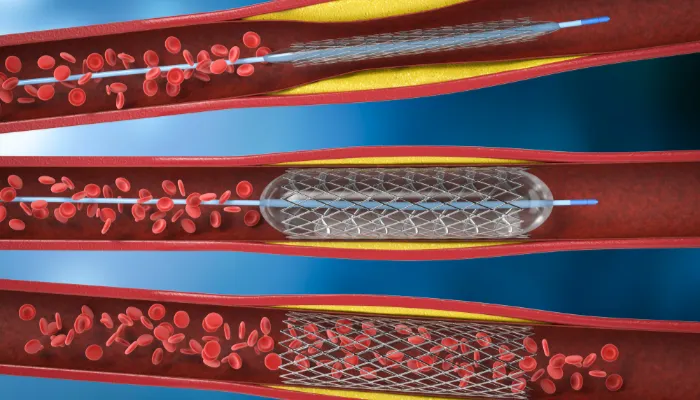
What is a Coronary Stent?
In most cases, angioplasty is combined with the placement of a small expandable wire mesh tube called a stent. The stent is left permanently in the artery to keep it open and prevent it from narrowing again. Most stents used today are drug eluting stents (DES), coated with medication that is slowly released to prevent scar tissue formation and reduce the risk of re-narrowing. In selected cases, bare metal stents may be used.
When is Coronary Angioplasty Recommended?
Angioplasty is recommended when:
- Medications and lifestyle changes have not adequately controlled angina or chest pain
- A coronary angiography has confirmed a significant blockage in one or more coronary arteries
- A patient presents with an acute heart attack requiring immediate restoration of blood flow
- Non-invasive tests such as TMT or stress echo suggest significant coronary ischaemia
- A blockage is suitable for percutaneous treatment rather than bypass surgery
How is Coronary Angioplasty Performed?
The Procedure Step by Step
Coronary angioplasty is performed under local anaesthesia and mild sedation. The patient remains awake and comfortable throughout. The cardiologist makes a small puncture, most commonly at the wrist (radial approach) or occasionally at the groin (femoral approach), and inserts a sheath to access the artery.
A thin guide wire is advanced through the catheter and positioned across the blockage in the coronary artery. A balloon catheter is then passed over the guide wire to the site of narrowing. The balloon is inflated for a short duration to compress the plaque and open the artery. A stent is then deployed at the same site by inflating another balloon, which expands the stent and locks it in place against the artery wall. The catheter and wires are then removed and the access site is closed.
The entire procedure typically takes 30 to 90 minutes depending on the complexity and number of vessels treated.
Radial vs Femoral Approach in Nagpur
At Swasthyam Superspeciality Hospital, our interventional cardiologist has specialised expertise in the radial route approach, where the catheter is inserted through the wrist artery. This approach is associated with significantly less bleeding risk, greater patient comfort, earlier mobilisation, and faster discharge compared to the traditional femoral (groin) approach.
Benefits of Having a Coronary Angioplasty
Coronary angioplasty offers significant advantages for patients with blocked coronary arteries, particularly when compared to open heart surgery:
- Immediate relief from chest pain and breathlessness in most patients
- Minimally invasive with no large incisions or general anaesthesia
- Significantly shorter hospital stay, typically 1 to 2 days
- Faster return to daily activities and normal life
- Reduced risk of heart attack in patients with severe coronary blockage
- Life-saving treatment when performed immediately during a heart attack
- Can be performed on multiple vessels in the same or subsequent sessions
Best Hospital for Coronary Angioplasty in Nagpur
At Swasthyam Superspeciality Hospital, our cardiology department is recognised for its expertise in performing coronary angioplasty, complex coronary interventions, and a wide range of cardiac procedures for patients across Nagpur. Our team includes an experienced interventional cardiologist, cardiac surgeon, and critical care specialists who work together to deliver personalised, multidisciplinary cardiac care under one roof. Whether it is a planned elective angioplasty or an emergency intervention following a heart attack, our team is equipped and ready to provide the highest standard of care at every stage.
What to Expect Before, During, and After Angioplasty Surgery
Before the Procedure
Our cardiology team at Swasthyam Superspeciality Hospital, Nagpur conducts a thorough pre procedure assessment before angioplasty. This includes a review of all current medications, blood tests including kidney function and clotting profile, ECG, and a review of recent angiography findings. Patients are advised not to eat or drink for at least 6 to 8 hours before the procedure. Blood thinning medications may be adjusted or started in advance as directed by the cardiologist. A consent discussion takes place explaining the procedure, its benefits, and potential risks.
During the Procedure
You will be made comfortable on the Cath Lab table with ECG leads, a blood pressure cuff, and an oxygen monitor attached. The access site is cleaned and numbed with local anaesthesia. You may feel mild pressure at the insertion site but should not experience pain. The cardiologist guides the catheter to the blockage using real time X-ray imaging, inflates the balloon, and deploys the stent. You may be asked to hold your breath briefly during imaging. The team communicates with you throughout and monitors your heart rhythm continuously.
After the Procedure
Following angioplasty, you are transferred to the cardiac recovery area where your heart rate, blood pressure, and access site are monitored closely. Most patients are able to walk within a few hours of a radial approach procedure. You will be started on dual antiplatelet medications which must be taken consistently as prescribed to prevent stent clotting. Most patients are discharged within 24 to 48 hours. A follow-up appointment with the cardiologist is scheduled within 2 to 4 weeks to review recovery and medication response.
Why Choose Swasthyam Superspeciality Hospital for Angioplasty in Nagpur?
Advanced Cardiac Catheterisation Facility in Nagpur
Our Cath Lab is equipped with high precision flat panel imaging technology enabling accurate real-time visualisation during angioplasty. The facility supports complex interventional procedures including FFR and IVS guided assessments for borderline blockages.
Expert Interventional Cardiologist with Radial Specialisation
Dr. Pankaj Harkut brings over two decades of experience in coronary angioplasty and stenting, with specialised expertise in radial route interventions and complex coronary cases. He played a key role in establishing a dedicated radial programme during his tenure at Sir J.J. Hospital, Mumbai.
24x7 Emergency Care
For patients arriving with an acute heart attack, our Cath Lab is operational round the clock. Emergency primary angioplasty is initiated without delay, giving every patient the fastest possible chance of restoring blood flow and saving heart muscle.
Frequently Asked Questions
Is coronary angioplasty a major surgery?
No. Angioplasty is a minimally invasive procedure performed through a small puncture in the wrist or groin. It does not require open heart surgery, general anaesthesia, or a large incision.
How long does angioplasty take in Nagpur at Swasthyam?
The procedure typically takes 30 to 90 minutes depending on the number of vessels treated and the complexity of the blockage.
Is Coronary Angioplasty safe?
Yes, coronary angioplasty is a safe and commonly performed procedure with a low risk of complications. Most patients recover well and experience improved blood flow to the heart.
How soon can I return to normal activities after angioplasty?
Most patients return to light daily activities within a few days. Full recovery and return to work typically takes 1 to 2 weeks. Your cardiologist will provide specific guidance based on your individual case.
What is a drug-eluting stent?
A drug-eluting stent is a metal mesh tube coated with medication that is slowly released to prevent scar tissue from forming inside the stent, significantly reducing the risk of re-narrowing compared to bare metal stents.
How do I book an angioplasty consultation in Nagpur at Swasthyam?
Call +91 8600888444 or visit our OPD at 97/98, Vivekanand Nagar, Near Sai Mandir, Wardha Road, Nagpur 440015. You can also book online through our website.
Can angioplasty be performed on more than one blocked artery at a time?
Yes. In many cases, multiple blockages can be treated during the same procedure or in staged sessions depending on the complexity of each blockage and the patient’s overall cardiac condition.